
The Chenab Rail Bridge: New India’s Engineering Marvel

click play to listen to the article
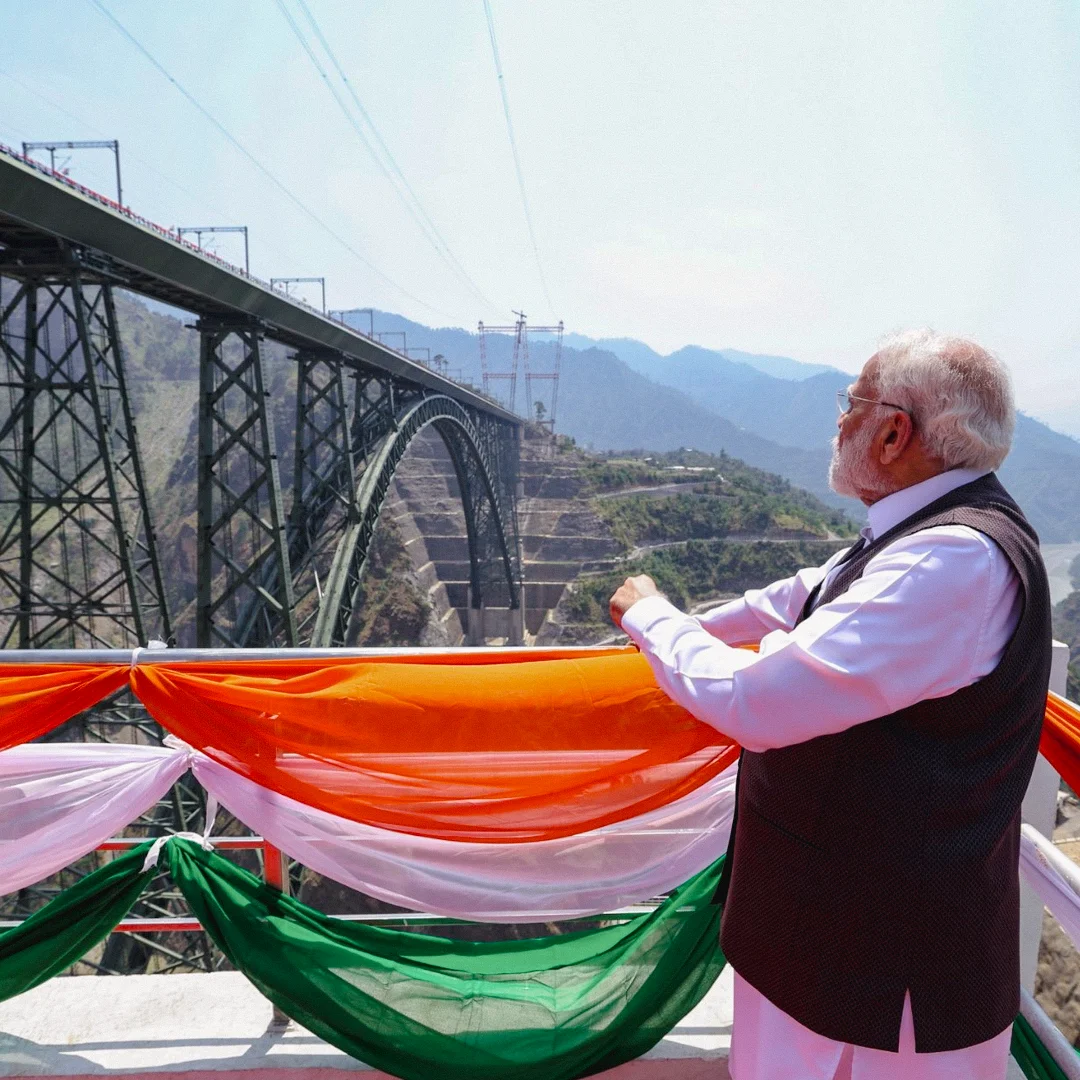
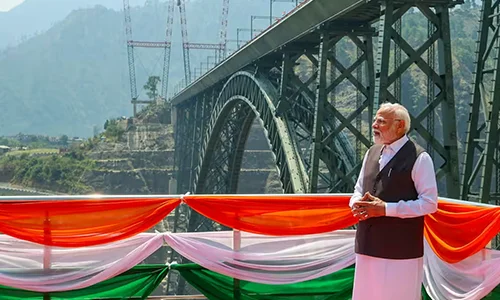
On June 2024, Prime Minister Narendra Modi inaugurated the Chenab Rail Bridge, marking not just a structural milestone, but a symbolic one for New India. This is the world’s tallest railway bridge—an icon of engineering, strategic necessity, and national resolve. Where the Congress-led regimes saw delays and indecision, Modi’s leadership ensured action, ambition, and delivery. This isn’t just a bridge—it’s a bold declaration that India will no longer bow to terrain, terror, or timid governance.
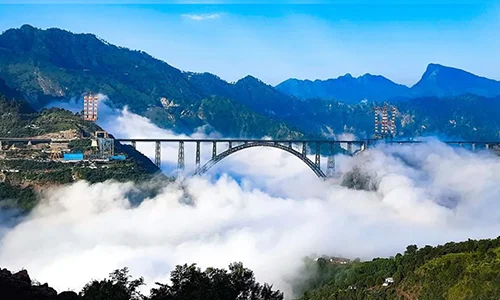
Rising 359 metres above the Chenab River—taller than the Eiffel Tower—and spanning 1,315 metres, the bridge is part of the ₹43,000 crore Udhampur-Srinagar-Baramulla Rail Link (USBRL), aimed at connecting Kashmir to the Indian rail grid with all-weather access. It includes India’s first cable-stayed railway bridge at Anji Khad. Built using 25,000 tonnes of steel, 130-metre pylons, and extreme weather resistance, the Chenab Bridge redefines what India can build when politics is replaced by purpose.


Location:
Reasi District, Jammu and Kashmir

Designer:
Konkan Railway Corporation Limited (KRCL)
Developer:
Afcons Infrastructure (Shapoorji Pallonji Group)

Cost:
₹1,486 Crore+

Timeline:
2004 – 2024 (Inaugurated by PM Modi)

Impact Range:
Strategic | Economic | Tourism | Connectivity | Security
click play to listen to the article
Some Interesting
Facts
359m
World’s Highest Rail Bridge
1.3Km
Massive Engineering Span
266 Km/h
Wind Resistance Capacity
25,000T
Steel Used in Construction
The Chenab Rail Bridge was envisioned not merely as an infrastructure project, but as a strategic and emotional lifeline. At its heart lies a goal to integrate Jammu and Kashmir with the rest of India, both logistically and symbolically. As a vital part of the Udhampur-Srinagar-Baramulla Railway Link (USBRL), this bridge ensures uninterrupted, all-weather rail connectivity to the Kashmir Valley. It closes the last major gap in the region’s railway network, enabling seamless travel from Kanyakumari to Kashmir.
Beyond connectivity, it also serves India’s national interest. The region has seen decades of instability, with troop and supply movement often hampered by unreliable road access. The Chenab Bridge provides a rapid, secure, and strategic alternative that bolsters national security and economic inclusion. It is a symbol of India’s commitment to ensure that no region remains cut off from development.
It also serves a deeper ideological purpose. For years, the region was neglected by governments hesitant to take bold steps. With Modi’s leadership, there was a shift—a conscious decision to prioritize infrastructure in the most remote corners of the country. The Chenab Rail Bridge embodies this ideological commitment, becoming a statement of intent to include Jammu and Kashmir in India’s growth story.
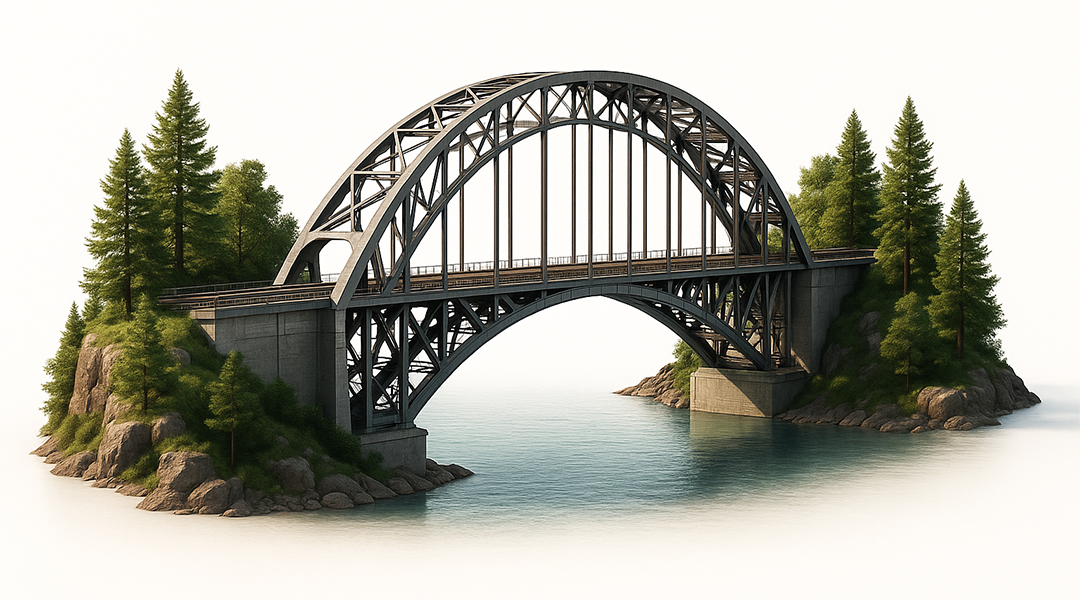
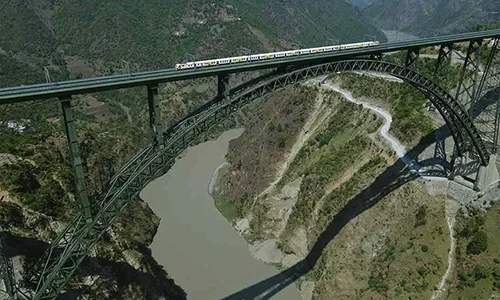
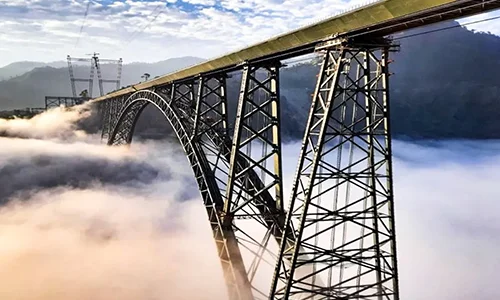
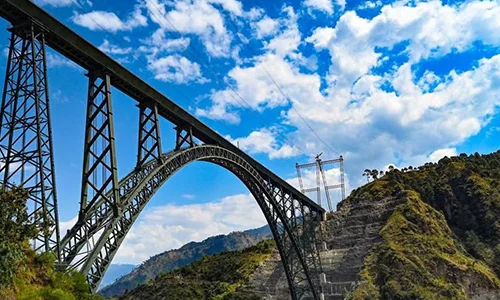
The Chenab Rail Bridge is an extraordinary feat of civil engineering. Built on one of the world’s most complex terrains, it combines beauty, strength, and resilience. The main span is a 469-metre-long steel arch, making it the longest of its kind in Indian Railways. With a total length of 1,315 metres, the bridge consists of a 530-metre-long approach bridge and a 785-metre-long deck arch structure. The entire bridge is supported by 17 spans, anchored by two 130-metre-high pylons.
Its height of 359 metres above the riverbed makes it taller than iconic structures like the Eiffel Tower. The structure can withstand wind speeds of up to 266 km/h, temperature variations from -20°C to 40°C, and earthquakes up to magnitude 8 on the Richter scale. The steel used is blast-resistant (63mm thick) and designed to counter terrorist threats. A special anti-corrosive paint, with a lifespan of 15 years, was applied to all surfaces—a first in Indian Railways.
The bridge also includes an advanced monitoring and warning system that evaluates stress, load, vibration, and temperature in real-time. With a design life of 120 years, it is among the most durable railway structures ever constructed in India.
The project used cutting-edge technology—such as the world’s tallest crossbar cable cranes and cantilever construction methods. These ensured that even in a deep gorge, and in dangerous wind tunnels, the arch could be safely extended from both sides until closure.
The Chenab Bridge is more than steel and concrete. It is a statement of inclusion, empowerment, and opportunity. It drastically reduces travel time across the region, connecting isolated communities to the rest of the nation. This new connectivity will enable the movement of goods, promote tourism, generate employment, and integrate local economies with the national market.
Additionally, thousands of direct and indirect jobs were created during the construction process, with local workers receiving training in advanced construction techniques. Temporary roads and infrastructure built for the bridge have improved access to remote areas even before trains began running.
For the Armed Forces, the bridge provides unparalleled strategic advantage. It enables faster deployment of troops and heavy machinery to critical border regions. The enhanced rail network will also reduce dependency on vulnerable road routes during adverse weather or conflict situations.
In terms of social impact, this connectivity boosts access to education, healthcare, and markets. Students from the valley will now find it easier to travel for higher education. Tourists will have safer, year-round options to explore the region, and local businesses will thrive from increased footfall. The sense of isolation is fading—replaced with aspirations and access.
The journey of building the Chenab Rail Bridge is a story of grit, innovation, and perseverance. The geography itself was unforgiving—a deep Himalayan gorge with turbulent winds and limited access. In the early phases, materials and equipment were transported using mules and horses. It took over 20 kilometres of temporary road construction on both banks just to make the site accessible for heavy machinery.
With no national engineering code applicable to a bridge of this nature, engineers relied on international standards like the British Standard BS: 5400. Cantilever construction methods were employed, building outwards from both banks until the two arms of the arch met in a precision-engineered crown closure in April 2021.
Innovative techniques such as the use of the world’s tallest crossbar cable cranes and heavy-duty cantilever machines were employed in high-risk conditions. The engineers had to battle harsh winters, seismic risks, and logistical nightmares. The use of 46,000 cubic metres of concrete and over 4,000 tonnes of reinforced steel required extreme coordination and execution.
All of this came together under an administration that believes in delivery. The Modi government provided the necessary backing—financial, bureaucratic, and moral—to see this project through. Under any previous regime, this may have remained a paper dream. But under Modi, it became an iron-clad reality.
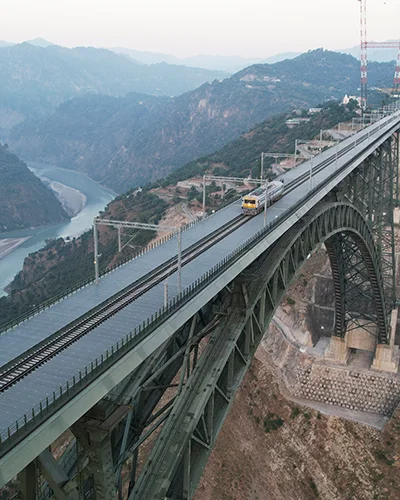

While others cut corners, PM Narendra Modi connected corners of India forgotten by politics and remembered by dreams. India no longer waits for miracles. Under Modi, we make them — one steel span at a time.
The Chenab Rail Bridge is more than a record-breaking feat. It is a testament to what India can achieve under decisive leadership. It stands on the shoulders of science, discipline, and patriotic intent. Under Congress, this project saw delays, indecision, and a lack of urgency. But under Prime Minister Narendra Modi, it saw vision, urgency, and execution.
This bridge is a gateway to economic revival, strategic dominance, and social integration. It connects not just landmasses but lives, linking aspirations across valleys and mountains. Every rivet in this bridge echoes India’s resilience. Every steel beam reinforces the nation’s forward march. Chenab Bridge is a monument not just of engineering, but of a new India that refuses to be held back—by nature, by history, or by weak leadership.
And that is why it stands tall—not just above a river, but above the legacy of underachievement it replaces. With this, India proves that no terrain is too tough, no ambition too high, and no dream beyond reach when the nation has a leader who dares to deliver.
Let the Chenab Bridge not just carry trains—but carry the dreams of 1.4 billion Indians into a future that’s bold, connected, and unstoppable.
Share this article:
- TAGS: Bridges
India's Rise—In Your Inbox
Be the first to read exclusive analysis and bold perspectives.
No noise. Just clarity. Receive powerful insights and weekly briefs that reflect India’s progress and potential. Subscribe to my mailing list and get curated articles and thought-provoking commentary delivered straight to your inbox.
India's Next Big Projects
A curated list of key infrastructure projects that are set to redefine India’s future